Introduction
The Goldmann Applanation Tonometry (GAT) is a commonly used method for measuring
intraocular pressure (IOP), which is crucial in the diagnosis and management of conditions such as
glaucoma. However, environmental factors, such as altitude, can affect GAT
readings. For instance, at higher altitudes, air pressure decreases, which can lead to variations in
intraocular pressure readings. In order to accurately assess IOP, it is essential to apply
altitude corrections.
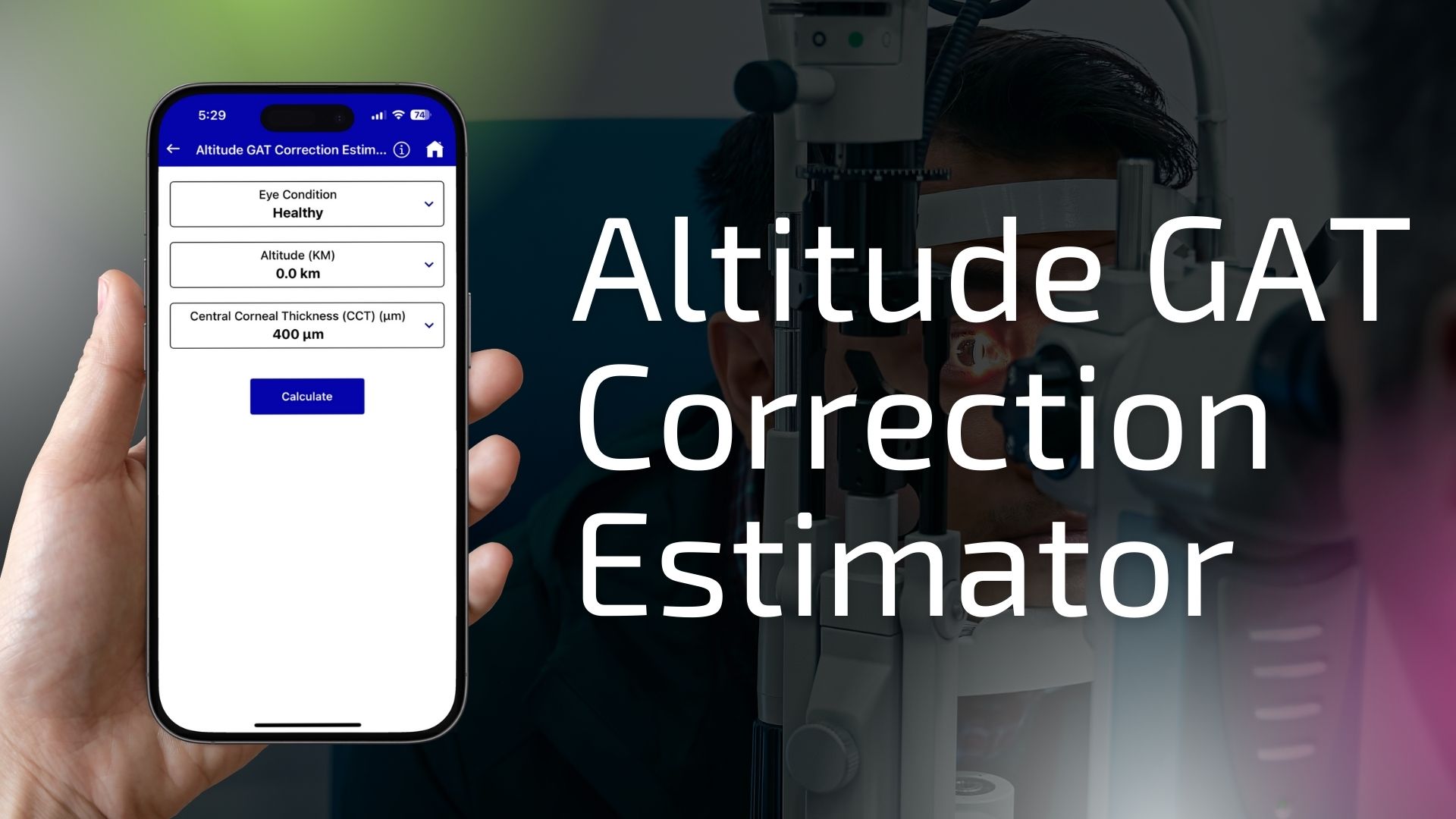
Key Variables for GAT Correction Estimation:
- Eye Condition:
- Healthy
- Glaucoma
- Keratoconus
- Corneal Transplants
- Refractive Errors (e.g., myopia, hyperopia)
- Altitude (in Kilometers): Altitude can affect the atmospheric
pressure, which may influence the accuracy of GAT IOP measurements.
- Central Corneal Thickness (CCT) (in micrometers): The CCT can
impact IOP readings. A thinner cornea often leads to an underestimation of the true IOP, whereas
a thicker cornea can result in an overestimation. This factor must be taken into account,
especially when correcting IOP measurements at different altitudes.
1. Eye Condition and Its Effect on GAT Readings:
Healthy Eyes:
Healthy eyes generally produce reliable GAT readings, though they can still be influenced by factors
such as CCT and altitude.
Glaucoma:
Glaucoma patients may show altered IOP readings, and it’s essential to correct for
altitude-induced changes to maintain accuracy. Thin corneas (as often seen in glaucoma patients) may
require additional corrections.
Keratoconus:
Keratoconus results in a thinner and more irregular cornea, which can distort GAT
measurements. The condition may further complicate altitude-related corrections due to its impact on
the corneal shape and structure.
Corneal Transplants:
Individuals who have had corneal transplants might have abnormal CCT readings. These
may vary based on the type of transplant (e.g., full-thickness vs. partial-thickness grafts) and can
significantly affect GAT readings. Adjustments for both CCT and altitude are necessary in these
cases.
Refractive Errors:
Refractive errors (like myopia or hyperopia) can cause some variance in GAT readings
due to differences in corneal curvature. However, they typically have less of an impact than other
eye conditions, although altitude corrections should still be considered.
2. Altitude (Altitude KM) and Its Impact:
At higher altitudes, the atmospheric pressure decreases, which can cause a reduction
in the pressure exerted by the air on the eye. This results in an alteration of the GAT reading.
Since the tonometer measures intraocular pressure based on the force required to flatten the cornea,
changes in atmospheric pressure can influence these readings. To accurately measure IOP at higher
altitudes, a correction factor is needed.
Example:
- At 1 km (1000 meters) above sea level, the atmospheric pressure is
approximately 0.9 atm.
- At 5 km (5000 meters), the atmospheric pressure drops to around 0.5
atm, leading to a significant potential difference in GAT IOP readings.
The estimator will factor in the altitude in kilometers and adjust the GAT
reading accordingly.
3. Central Corneal Thickness (CCT) (µm) and Its Role in GAT Correction:
CCT plays a crucial role in the accuracy of GAT IOP measurements. A thicker
cornea can artificially elevate the tonometer's IOP readings, while a thinner
cornea may result in an underestimation.
Healthy Eyes:
Normal CCT values typically range from 500 µm to 550 µm. Small deviations from this
range (e.g., < 500 µm or > 550 µm) can lead to slight
inaccuracies that must be corrected.
Glaucoma:
Glaucoma patients often have thinner corneas (e.g., <
500 µm), which may lead to an underestimation of true IOP. Thus, their GAT readings
require a more significant adjustment for both CCT and altitude.
Keratoconus:
Keratoconus usually results in a significantly reduced CCT, often in the range of
400 µm to 450 µm, leading to potential underestimation of IOP. Both altitude and
CCT require careful correction for accurate assessment.
Corneal Transplants:
Post-transplant corneas may have thicker CCT values (often over
550 µm) due to scar tissue or the type of transplant, which could overestimate IOP
readings. CCT correction is important for these individuals, especially when considering altitude
adjustments.
Refractive Errors:
Refractive surgery patients may experience altered CCT measurements (e.g., following
LASIK or PRK). This needs to be corrected for accurate IOP assessment.
4. Altitude GAT Correction Formula:
An example correction formula might look like this:
Corrected IOP = Measured IOP + (Altitude Correction Factor) + (CCT Adjustment)
Altitude Correction Factor adjusts for the decrease in atmospheric pressure at
higher altitudes.
CCT Adjustment is calculated based on the individual’s corneal thickness, using a
standard correction value (e.g., 0.2 mmHg per 10 µm of CCT deviation from 540 µm).